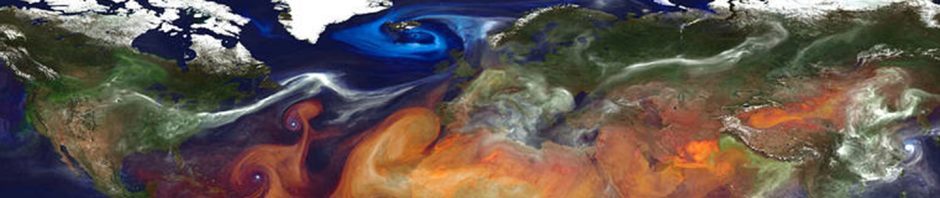
Our research group in UCLA‘s Atmospheric and Oceanic Sciences Department studies how aerosols—especially desert dust—interact with Earth’s climate system. The objective of our work is to reduce uncertainties in climate projections and to inform responsible climate intervention strategies.
What we do
We combine modeling, analysis of satellite, ground-based, and airplane observations, and theoretical studies to understand how aerosols are emitted and how they influence the climate system. Our research focuses on:
- Cloud microphysics: Aerosols can seed clouds, thereby altering cloud coverage, reflectivity, and lifetime.
- Earth’s energy balance: Aerosols scatter and absorb solar and terrestrial radiation and modify cloud properties, affecting how much energy enters and leaves the climate system.
- Climate feedbacks: Aerosol emissions respond to changes in climate, creating feedback loops that can amplify or dampen climate change.
- Climate intervention: We assess the feasibility, risks, and potential benefits of deliberately modifying aerosol-cloud interactions to temporarily reduce the impacts of climate change.
Why this research matters
Aerosols are among the largest sources of uncertainty in our understanding of past and future climate changes. Gaining a deeper understanding of how aerosols affect climate is critical for making more accurate predictions of Earth’s future climate. Such forecasts carry immense societal value—estimated in the trillions of dollars—because they help communities and governments better mitigate and adapt to climate change.
A second reason this research is so critical is the growing discussion about whether humanity should attempt to cool the planet by deliberately modifying aerosol interactions with radiation and clouds. Such interventions could temporarily reduce some of the worst impacts of global warming while the world transitions to a low-carbon economy. This approach—often referred to as geoengineering or climate intervention—raises profound questions about potential risks, benefits, and unintended consequences. The scientific consensus is that extensive research is urgently needed to fully understand the risks and benefits of the various proposed climate intervention techniques, especially as global temperatures approach the 1.5 °C and 2 °C global warming thresholds outlined in the Paris Agreement.
Within the broad field of aerosol-climate interactions, our group focuses primarily on desert dust aerosols – the tiny particles particles originating from dust storms. These dust particles constitute approximately two thirds of the total atmospheric aerosol mass and are vital to ice formation in mixed-phase and cirrus clouds.
For a detailed overview of our group’s research, visit our Research page. Our publications can be accessed through our Publications page, as well as through Google Scholar, ResearchGate, and ResearcherID.
The Aerosol-Climate Interactions research group is headed by professor Jasper Kok, and funded by the National Science Foundation, NASA, the Simons Foundation, the University of California Office of the President, and the Army Research Office.
 The Aerosol-Climate Interactions Group - UCLA